


疊代器模式 Iterator Pattern
1376 字
7 分鐘
疊代器模式 Iterator Pattern
目的
不用知道Aggregate Object的內部細節,即可依序存取內含的每一個元素
適用
- 即使對Aggregate Object內部結構一無所知,仍可存取物件內容。以多種方式巡訪Aggregate Object。以一致介面巡訪各種不同的Aggregate Object時(多型巡訪)。
結構及成員
Collaborations: ConcreteIterator記載已巡訪到聚合體的哪一個元素,並可依序巡訪下一個。
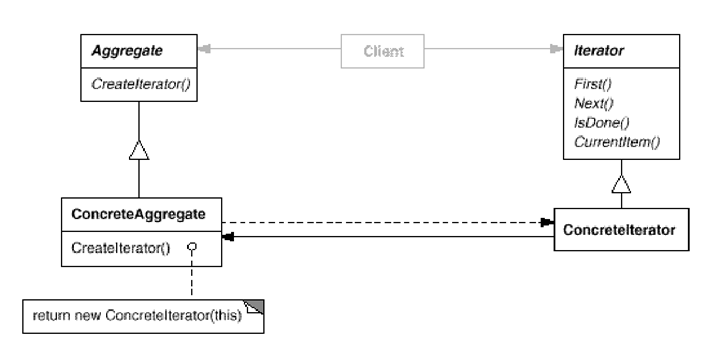
- Iterator:宣告存取巡訪元素的介面。ConcreteIterator: like the ArrayIterator, ListIterator, PreorderIterator具體實作出Iterator。記載正在巡訪的現行元素位置。Aggregate:此介面宣告出建立Iterator物件之操作。ConcreteAggregate:具體實作出建立Iterator物件之介面,傳回適當的ConcreteIterator物件實體。
影響結果
好處
- 可提供多種巡訪方式,可以輕易改變巡訪演算法,也可以衍生新的Iterator子類別提供新的巡訪方式。Iterator可簡化Aggregate介面。Aggregate不必覆寫巡訪方法。針對同一聚合體,可以同時存在許多Iterator在其中,各Iterator物件會記載自己的巡訪狀態。
壞處
- Iterator和Aggregate之間有額外的通訊負擔。
實作
誰來控制巡訪過程?
- 如果是由Client控制,這就是外部Iterator;由Iterator自己主導,就是內部Iterator。外部Iterator比內部Iterator更有彈性。
誰來定義巡訪演算法?
- Aggregate Object也可能會定義,此時Iterator只是拿來記錄巡訪狀態而已。這種Iterator就是Cursor,Client以游標當參數呼叫Aggregate Object的Next(),而Next()會改變游標的操作。如果有Iterator負責巡訪演算法,就很容易用不同方式巡訪同一個Aggregate Object。但巡訪演算法可能需要存取Private Attribute,會破壞封裝。
Iterator有多穩健?
- 在巡訪Aggregate Object的同時還去改變Aggregate Object的內容會很危險。若有增刪元素,就可能會重複存取,也可能完全略過。可以透過先複製一份Aggregate Object再巡訪來解決,但會耗效能。穩健(Robust)的Iterator不必將Aggregate Object再複製一份,大部分都需要向Aggregate Object索取Iterator物件,一有增刪動作,Aggregate Object會主動調整Iterator的內部狀態,或者乾脆自己維謢必要資訊以確保巡訪時的正常運作。
其他額外的Iterator操作
最小的操作會包含First()、Next()、IsDone()、CurrentItem()等,但也可能有Previous()、**SkipTo()**等。
Example:
GlyphStorage
// Abstract Aggregate (類似Java 的 abstract class List)// 自己設計的Storage資料結構public interface GlyphStorage { void add(int index, Glyph element); void add(Glyph element); void remove(int index); void remove(Glyph glyph); int size(); Glyph get(int index); Iterator iterator();}// Concrete Aggregate (類似Java 的 LinkedList或ArrayList)// 在此資料型態用array,但也可以是其他種// 內部的method()是為了array而設計,可以不深入研究public class ArrayGlyphStorage implements GlyphStorage{ private Glyph[] glyphs = new Glyph[10]; private int index = 0;
@Override public void add(int index, Glyph element) { int i = index++; expandArray(glyphs.length+1); for(int pos = i+1; i = glyphs.length) throw new ArrayIndexOutOfBoundsException(); return glyphs[index]; }
@Override public Iterator iterator() { return new ArrayGlyphIterator(this); }
private void expandArray(int size) { if(size >= glyphs.length) { Glyph[] newGlyphs = new Glyph[size]; System.arraycopy(glyphs, 0, newGlyphs, 0, glyphs.length); glyphs = newGlyphs; } }}// Concrete Aggregate (類似Java 的 LinkedList或ArrayList)// 在此資料型態用arrayList,但也可以是其他種// 內部的method()是為了arrayList而設計,直接拿內建arrayList來用public class ListGlyphStorage implements GlyphStorage{ private ArrayList glyphs = new ArrayList<>(); private int index = 0;
@Override public void add(int index, Glyph element) { glyphs.add(index, element); }
@Override public void add(Glyph element) { glyphs.add(element); }
@Override public void remove(int index) { glyphs.remove(index); }
@Override public void remove(Glyph glyph) { glyphs.remove(glyph); }
@Override public int size() { return glyphs.size(); }
@Override public Glyph get(int index) { return glyphs.get(index); }
@Override public Iterator iterator() { return new ListGlyphIterator(this); }}// Concrete Iterator 繼承 Java內建的 Iterator// 專屬於 ArrayGlyphStorage的Iterator// 像 ArrayList和ArrayListIterator的關係public class ArrayGlyphIterator implements Iterator { int position = 0; ArrayGlyphStorage arrayGlyphStorage; public ArrayGlyphIterator(ArrayGlyphStorage arrayGlyphStorage){ this.arrayGlyphStorage = arrayGlyphStorage; }
@Override public boolean hasNext() { if(position >= arrayGlyphStorage.size() || arrayGlyphStorage.get(position) == null) return false; return true; }
@Override public Glyph next() { return arrayGlyphStorage.get(position++); }
@Override public void remove() { arrayGlyphStorage.remove(position-1); position -= 1; }}// Concrete Iterator 繼承 Java內建的 Iterator// 專屬於 ListGlyphStorage的Iterator// 像 LinkedList和LinkedListIterator的關係public class ListGlyphIterator implements Iterator { int position = 0; ListGlyphStorage listGlyphStorage; public ListGlyphIterator(ListGlyphStorage listGlyphStorage){ this.listGlyphStorage = listGlyphStorage; }
@Override public boolean hasNext() { if(position >= listGlyphStorage.size() || listGlyphStorage.get(position) == null) return false; return true; }
@Override public Glyph next() { return listGlyphStorage.get(position++); }
@Override public void remove() { listGlyphStorage.remove(position-1); position -= 1; }}// 用例public class MyGlyphIteratorPattern {
public static void main(String[] args) { GlyphStorage storage = new ArrayGlyphStorage(); storage.add(new Row()); storage.add(new Text()); storage.add(new Image());
Iterator iterator = storage.iterator(); //仿JAVA內建Iterator的用法 while(iterator.hasNext()){ System.out.println(iterator.next().detail()); } }}Result:
This is row glyphThis is text glyphThis is image glyphShape
//Class: Shape
package iterator.shape;
public class Shape {
private int id; private String name;
public Shape(int id, String name){ this.id = id; this.name = name; }
public int getId() { return id; } public void setId(int id) { this.id = id; } public String getName() { return name; } public void setName(String name) { this.name = name; }
@Override public String toString(){ return "ID: "+id+" Shape: "+name; }
}//Class: ShapeStorage
package iterator.shape;
public class ShapeStorage {
private Shape[] shapes = new Shape[5]; private int index;
public void addShape(String name){ int i = index++; shapes[i] = new Shape(i,name); }
public Shape[] getShapes(){ return shapes; }}//Class: ShapeIterator
package iterator.shape;
import java.util.Iterator;
public class ShapeIterator implements Iterator{
private Shape [] shapes; int pos;
public ShapeIterator(Shape[] shapes){ this.shapes = shapes; } @Override public boolean hasNext() { if(pos >= shapes.length || shapes[pos] == null) return false; return true; }
@Override public Shape next() { return shapes[pos++]; }
@Override public void remove() { if(pos <=0 ) throw new IllegalStateException("Illegal position"); if(shapes[pos-1] !=null){ for (int i= pos-1; i<(shapes.length-1);i++){ shapes[i] = shapes[i+1]; } shapes[shapes.length-1] = null; } }}//Class: TestIteratorPattern
package iterator.shape;
public class TestIteratorPattern {
public static void main(String[] args) { ShapeStorage storage = new ShapeStorage(); storage.addShape("Polygon"); storage.addShape("Hexagon"); storage.addShape("Circle"); storage.addShape("Rectangle"); storage.addShape("Square");
ShapeIterator iterator = new ShapeIterator(storage.getShapes()); while(iterator.hasNext()){ System.out.println(iterator.next()); } System.out.println("Apply removing while iterating..."); iterator = new ShapeIterator(storage.getShapes()); while(iterator.hasNext()){ System.out.println(iterator.next()); iterator.remove(); } }
}Result:
ID: 0 Shape: PolygonID: 1 Shape: HexagonID: 2 Shape: CircleID: 3 Shape: RectangleID: 4 Shape: SquareApply removing while iterating...ID: 0 Shape: PolygonID: 2 Shape: CircleID: 4 Shape: Square文章分享
如果這篇文章對你有幫助,歡迎分享給更多人!
疊代器模式 Iterator Pattern
https://linziyou.info/posts/2020-10-07-疊代器模式-iterator-pattern/ 最後更新於 2020-10-07,距今已過 1992 天
部分內容可能已過時